
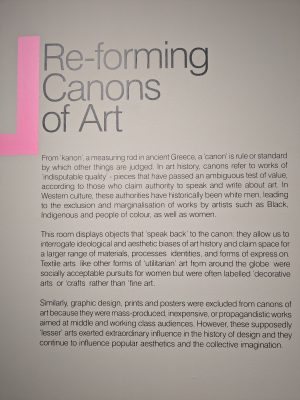
 I learned something the other day when visiting the Hunterian Art Gallery in Glasgow. In one of the rooms, there was an explanatory sign (see photo) about the word ‘canon’, meaning a collection of works recognised as being of enduring value and importance.
I had never known that ‘canon’ derives from the ancient Greek word ‘kanon’, a measuring instrument, usually a stick, reed or rod used to ensure straight lines and accurate measurements. I suppose we still use that concept when we talk of ‘a yardstick’, a standard or measure against which other things can be judged.
The derivation of ‘canon’ was pleasing to know. For me, the canon has always been a slightly murky concept. How did things get into it, I used to wonder? Who decided? I imagined a celestial panel of judges looking down and plucking out certain works to be placed on the ‘immortal’ shelf.
‘In art history’, the signboard explained, ‘canons refer to works of ‘indisputable quality’ – pieces that have passed an ambiguous test of value, according to those who claim authority to speak and write about art. In Western culture, these authorities have historically been white men, leading to the exclusion and marginalisation of works by artists such as Black, Indigenous and people of colour, as well as women.’
I was intrigued by the use of the word ‘ambiguous’ – as in ‘ambiguous test of value’. Hmmm! So, maybe not a pure and eternal judgement, then, but a test applied by people with their own set of values to uphold, or their own status to preserve?
In classical music, when we speak of ‘the canon’ we mean Bach, Mozart, Haydn, Beethoven, Schubert, Schumann, Brahms, Wagner and co. All wonderful composers, and still beloved today, but the celestial panel of judges convened in the late 19th century must have been led by Austrians or Germans.
I found myself wondering who would be in the canon if those with the power to confer immortality had been a completely different bunch of people, with different life experience, and different measuring-sticks.



How interesting! In this context, it’s good to know that you have been doing your best to shine a light on women composers.
I have strongly held opinions on this issue, but it has become a polarized debate where one can hardly say anything without risking the incoherent fury of one side or the other, or both. So I will have to pass. Suffice it to say that I think the truth is far more subtle and interesting than either extreme position.
I too have strongly held opinions and am nervous about expressing for similar reasons but I will try. Many Western male composers of classical music from the past have written works which have fallen into obsolescence. They didn’t stand the test of time – because they were unlucky or just not as good. Women composers were a rarity in the Western ‘canon’ for obvious reasons. I read your wonderful book on women and the piano for example. It was of its time and regrettable when we wonder what treasures would have been possible and the ones they have been dismissed due to sex bias. I too wonder at the gallery’s use of the word ‘ambiguous’ in questioning the accepted version of the Western classical music canon in terms of its collators. Experts can get things wrong but generally they are experts for a reason- hence I go to hear you Susan and your pianist peers perform, rather than amateurs! For me the genius of Beethoven’s music transcends his biological maleness . I listen to his music not thinking that it was written by a ‘dead white male’ . He changed music. Wagner also evolved and changed music( frightful politics not withstanding ) All the ‘greats’ did something great. I look forward to the future while enjoying the past. No regrets. My son’s university has a ‘decolonising the curriculum’ student rep in his music department. My other son told me these reps were instated in every department in his university also . I wonder how that translates ? Do we no longer study the musical ‘greats’ because they are ‘dead white makes’ and write our dissertations on Hip Hop or preferably a non western ethomusicological topic – (university music departments are awash with professors of ethnomusicology now all researching and teaching non western music) What is it doing to our young people’s education re Western classical music if we are falling over ourselves in academic musicological institutions to veer away from the study of harmony and counterpoint and musical analysis? Interestingly and meanwhile, Chinese and Korean nations are embracing Western music art form enthusiastically because they seem to know its value.. I could go on. I quite like the Western ‘canon’ !
Thank you Orla, and thank you to everyone else too for expressing these very interesting and valuable views. I’m grateful to you all for sharing them with me.
And thank you for generating the means for discussion. It is always more interesting to me to read everyone’s ideas and responses than my own. .Utimately music, including World Music! Is such a joy !
Thank you for your intelligent and nuanced contribution. Fashions come and go in all things, but only truth endures.
James
Good evening
I think everyone will have a different opinion as opposed to what constitutes “truth” in music. Not sure I would want to live in a world where one particular style is deemed to be “the truth” at the exclusion of others. What do you consider to be “truth” in music ? Does this mean something like Mozart who resonates with a large proportion of people who love Classical music or even the cool, logical clarity of Bach? Would you extend your definition to someone like the Avant Garde saxophonist Albert Ayler who rejected the more academic approach to jazz in the late 1960’s with a more primeval approach that reflected field hollers and New Orleans marches? (One of his compositions is entitled “The truth is marching in” and would have made a lot of sense in the political climate in the US of that time.) Is Mozart more “truthful” than a Blues musician like Blind Lemon Jefferson who sang about the kind of life he lived in the 1920’s. Does Jefferson’s life make the music he created more truthful than someone like a contemporary blues musician such as Gary Clark Jr.
Picking up on Orla’s comments, I am not convinced about the “dead, white male” argument either. I think there are composers like Bach whose merit cannot be credibly challenged but we are more exposed to so much music through the internet these days that the merits of music from other cultures can be celebrated alongside JSB. I do not see it as an “either / or” scenario. It is true that good quality music will survive and remain part of the cultural imprint whether it is those composers listed in the blog or Louis Armstrong’s Hot 5/7’s, Charlie Parker, Jimi Hendrix or Charley Patton . We should embrace a wider selection of artists and not corral a select number into a “canon.” I think the passage of time is also a double edge sword too. Some music does become obsolete after time whereas there are plenty of others who take a like while to become accepted like Charles Ives in classical music or Herbie Nichols in jazz. You also can get other composers like Gottschalk who were of their time but have been marooned by the passage of events so that they have a relevance to the pre-history of jazz albeit the composer could never have envisaged how some of his music would have been perceived with the emergence of jazz.
I always think that humans are separated by other animals by the fact that we produce art and play sports. The notion of a “canon” therefore is a non-starter for me as it is so narrow minded and indicative of the perceptions of what was important in the mid 19th Century. I am enjoying reading these comments and it is difficult for me to to rein in the temptation to offer the mischievous suggestion that was Alfred Brendel a clandestine Thelonious Monk fan?
I think that this is an endlessly fascinating topic
Ian, thank you for your interesting reply. Precisely where the distinction lies between opinion and truth is to me one of the eternal mysteries. For example, the pleasant lady who lives over the road from me wears bright pink jumpers with day-glo orange trousers. It is unarguable to me that these colours do not go together, but clearly she sees things differently. Similarly, it is plain to me that Mozart is a great composer. I respect the right of others to disagree, but I don’t say “Mozart is a great composer but all opinions are of equal merit and so I’ll pipe down.” When we hold strong opinions, we surely do so because we believe they are, in some sense, objectively true. Yet one must admit that this is not quite in the same category as 2 plus 2 making 4. It is as you say an endlessly fascinating grey area, and certainly a lot better than pink with orange!
I have to say that this is a question that has perplexed me for ages and one which often comes up in accounts of French composers trying to make claims for their music in the face of the critical opinion of the time which was in favour of those deemed part of a Germanic “canon.” I would guess that this notion cemented itself in the mid 19th century and I often wonder how much Mendelsohn was responsible for this as Bach had lapsed into obscurity prior to his discovery, therefore making his inclusion prior to this unlikely. It always struck me as odd that, even with a 19th century mindset, Chopin should be excluded from such a list ! Whenever I listen to Beethoven sonatas, my immediate reaction is that the stress and tumult in his piano works would have been alleviated if he had Chopin’s harmonic language. I find it fascinating that such an idea as a “canon” should still inform how Classical music is viewed in our times and how pianists like Alfred Brendel have perpetuated this perception. If you are measuring harmony and rhythm in classical music, the music in the Canon can seem a little naive afterwards. Isn’t it time that the canon was challenged?
I am not particularly keen on the piano music of Mozart, Beethoven or Schubert and worked backwards through Messiaen, Bartok, Scriabin and Debussy when I first started to listen to classical music. This was because I was particularly interested in those composers who had been an influence on the jazz musicians I listened to. For me, classical piano music is more appealing if the the harmonies are more colourful or if the music is more rhythmic. This is why, I regret ,that I find Brahms to be unlistenable. In my opinion, it is the composers listed in the Wigmore Hall recital who tick all the right boxes when I listen to classical music. I do love Bach and Haydn and am starting to appreciate Schumann. In my opinion, the work of Bach and Beethoven’s symphonies go beyond being part of a “canon” and a statements of the human condition as much as the plays of Shakespeare – my teacher used to say the between them, Bach and Shakespeare said all that was necessary about humanity. However, even if you restrict the canon to piano music, there is so much that is more rewarding to check out that those listed in the original Blog. By and large, so much more had happened with piano music after Chopin. The canon just seems reflective of a mindset from 175 years ago and the dominance of German and Austrian composers at that time,
If you were being hyper critical about who would be in a “top ten” of classical music, we have moved on from 19th century and the list would have to include Bartok, Debussy and Messiaen at the very least in addition to the omission of Chopin. Perhaps 20th century music has accelerated at such a rate and been so varied that it makes proposing an updated canon impractical. Excluding Bach, you can trace a logical degree of evolution from Mozart on to Brahms. Not sure about Wagner but 20th century music shot off in all kinds of directions making it difficult to collate the likes of Stravinsky, Debussy, Schoenberg , Prokofiev, Bartok, Ellington, etc into a consistent body of related work. It became far too diverse.
I find that many obscure composers are seriously underrated and are frequently more interesting than the Germanic composers listed, All in all, in 2026 it is a bit lazy to talk about these German composers as “The canon” and I do feel that it is more than a bit outdated. However, there is a similar scenario with jazz soloists with the importance of musicians like Armstrong, Young, Parker, Davis, Coltrane and Ornette being stressed as defining the parameters of jazz but referred to a the “tradition ” as opposed to the “canon.” The notion is not unique to Classical music.
I would be interested to read what James’ strongly held opinions are.
The word ‘classical’ in the phrase ‘classical music is significantly ambiguous. Still: I think that I hear a distinct change in musical language in the works of Lionel Power and John Dunstable, just as I see a distinct shift between Cimabue and Giotto. So if I let the phrase ‘European classical music’ point (for better or worse) to music written in Western Europe after that change and before (roughly) ‘The Rite’ and ‘Pierrot Lunaire’, then any so-called canon which doesn’t include (at least) Josquin, Palestrina and Victoria amongst its central composers
would surely have something badly wrong with it.