
 I’ve returned from London, where I recorded an album for Hyperion of piano music by some of the women featured in my book. I had a wonderful recording team. Incredibly, it’s now 40 years since I first recorded an album with producer Andrew Keener, now a doyen of the recording scene.
Recording is such hard work, in a different kind of way from anything else I usually do. In concerts I try to drop all my detailed practising thoughts into the background and focus on the shape and the musical feeling. I don’t tend to mind if there are little fluffs here and there – it all feels part of live music-making.
In a recording, however – a considered studio recording rather than the recording of a live concert – it’s not appropriate to allow little fluffs, outright mistakes and extraneous noises to be captured forever by the microphones. This becomes quickly evident once you’ve recorded a few things and listened back to them along with the producer and the sound engineer. Annoying ‘little’ errors are writ very large. You really don’t want to hear them on the finished product. So, back to the piano to try again. And try not to make the piano stool creak this time!
I find the process not unlike that of proofreading a book. You have one ear on the musical shape and sense, and another on the fine details as they pass by. You know that every note has to be perfect at some point. So your brain seems to slow down and check every note or chord for accuracy as it passes by. Obviously this kind of close listening is difficult to combine with getting carried away by the music. There does seem to be a sweet spot where you’re aware of detail but also able to focus on the longer arc (usually after recording the same passage multiple times). It’s probably never as carefree as it can be in concert, but with luck one can get satisfying ‘complete takes’ into which small corrections can be dropped during the editing process.
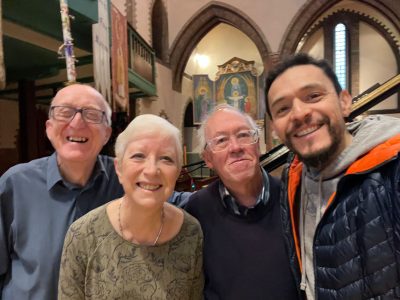
Photo shows the team: producer Andrew Keener, me, page-turner Peter Avis and sound engineer Oscar Torres. Thank you to all of them for making this such a pleasant experience!

I admire recording artists so much for this delicate balancing act. No wonder Schnabel called the recording studio “the torture chamber”! I sometimes wish somebody would record me without me knowing it, so that I have the freedom of living in the moment but the pleasure of a recording afterwards…
Oh can’t wait to have this recording Susan. As I may have said I had the pleasure of hearing you live playing this repertoire at Wigmore to celebrate the launch of the book on Woman and the piano. My husband ‘took’ me as a birthday gift. It was such an occasion and I said to you in the queue when you signed our copy that I hoped you’d record it. We were quite embarrassed taking up a place in a long queue at the time and we wondered how it must feel for you to have to make polite conversation with numerous strangers after such a tour de force. I bet you couldn’t wait to sit silently and alone and breathe but you were so patient. Part of the deal I suppose. Real congratulations on getting the recording done. Very exciting.
Susan
Good evening
It is good that you are recording a disc by female composers. I am finding that some of the lesser known and obscure composers are often unjustly neglected and there is so much out there to explore that it is unlikely that anyone can be bored. There are plenty of female composers who I have discovered from the 19th century onwards who I love to listen to and it is good that people increasingly want to record this music.
The one issue I have found is that you can hear a lot of this music on Youtube or busy discs where it is performed but I have increasingly found that is my interest is piqued, the sheet music is not available. I quite like the Henle Verlag editions as I can read them clearly but there are very few female composers on their roster. (Quite salutary when you assess who is missing from the library of HV, Schirmer, etc. You also find the more obscure composer’s works are, the poorer the quality of the printing and this can be dreadful in some instances. It is a bit off-putting if you just play for your own amusement like me and want to understand how something “works.” Taking your example of Maria Syzmanowska, I could find her music on Youtube (which I enjoyed ) but sites like Amazon and Musicroom had nothing by her amongst the manuscript. (Plenty of Syzmanowski , though, which I have bought. He does not get enough credit either although far more than his fellow Pole.)
In my experience most jazz musicians either have a “Fake book” of their music or you can buy from them directly on line if you are a fan. I think that the range in jazz books is also far more niche and you can buy the music of all sorts of esoteric jazz pianists. With Classical music, I am finding somethings just do not appear to exist or are parts of compilations or expensive volumes. If music piques my interest, it is easy to be able to listen and explore. The opportunities to learn their music seem less readily available.
Not surprising female composers remain unfamiliar when their music is often unavailable to play. Just wondered if this was a trend as the publication of works by composers like CPE Bach seem less readily available. Personally, I much prefer to explore the underdogs whose work deserves more attention.
Cheers
Ian