
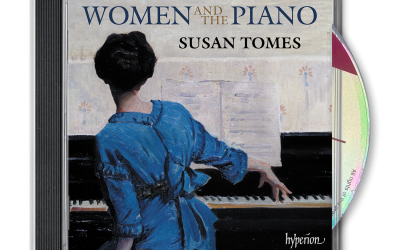
 Last week I did an interview about my new Hyperion album for KBACH, a classical music radio station in Phoenix, Arizona. The interview aired in Arizona today and I’m sharing a link in case anyone wants to listen to it.
For technical reasons, I had to wear headphones to do the interview. I’m not used to doing this, and the sound of my own voice through the headphones was quite disconcerting, which probably explains my hesitant delivery here and there. Nevertheless, I was delighted to be in touch with listeners in Arizona.
For reaching out to me so quickly after the record came out, I’m grateful to Michael Keelan, one of the hosts at KBACH.
Click here if you’d like to listen to the interview.
Susan
Good evening
That was an interesting interview. The comment that intrigued me was about when you noticed just how few composers in your collection were women. It made me really curious to find out how broad your tastes were. There was an interview on Radio 3 last week where pianist Imogen Cooper discussed her retirement and her desire to explore less familiar music without the pressure of preparing for concerts. I had never thought about the idea of professional pianists working on particular repertoire to the detriment of less familiar works which held more interest. The interview made me think about what other works beyond your recording that you are passionate about and whether you had a music room like my piano teacher’s where the two pianos and every other available space seemed to be covered in music books.
I agree that much of the repertoire of female composers has historically been neglected but I think that people are far more accepting these days of their works and that the public is very open to this these days. From my own perspective, the whole issue centres around whether a recording, a book, a blog or an online article can pique your interest enough to explore the music. I do think that you are correct about the domination of German / Austrian and French composers if often to the detriment of works by composers from other countries who are outside of the “canon” even though I am a fan of French music which I got into through the works of arranger Gil Evans.
It was quite interesting to hear you comment about the lack of female composers in your collection but the broader issue for me as a music fan is what music is in your library that you would like to “put out there” as deserving more attention. Imogen Cooper alluded to learning unfamiliar work but I wondered if there were other composers such as the women writing Sonatas you would either record, perform or advocate if you were given free rein? Do you ever pick up sheet music to play out of curiosity and how much of this is outside the repertoire you as generally associated with. I do think that the internet has made access to music a lot easier and has allowed people to access all sorts of obscure music. You can download practically anything which takes your fancy , whether a piano piece by Louise Farrenc (prompted by an online debate) of obscure jazz composers like Herbie Nichols and Elmo Hope. None of this stuff existing when I started learning. I do think that the internet has driven the interest in composers like Cheminade , Farrenc and Florence Price. You can download sheet music for a few quid which means it does not matter if it is not very good or too difficult to play. You can satisfy your curiosity about music very cheaply these days although I am wary of some of the websites which might not be legit.
There was a post on a piano forum I found earlier this week which discussed the repertoire written for the instrument by Heitor Villa-Lobos which someone had described as the greatest body of piano works which has largely been ignored by both performers and listeners. This really resonated with me having enjoyed listening an 8-volume set of his complete piano works and struggling to play his simpler work having been inspired by these CDs. For me, he was a great composer and perhaps being primarily a cellist as opposed to a pianist, he could approach the instrument from a different perspective and not restricted by traditions. Some of the most interesting musicians that I enjoy listening to come from approaching their instruments in a very original fashion, including Thelonious Monk, trumpeter Kenny Dorham, violinist Billy Bang, etc. I am far more attracted to music which is unfairly neglected or approaches it from a wild and inspired perspective. Radio 3 played the Lutoslawski “Pagonini variations” when I was driving to site earlier this month and this capsulates the unfamiliar and original approach to music that really appeals to me. It does feel to me that the reputation of much classical music is a bit topsy-turvy.
I am really intrigued by the sheet music you have in your collection and what kind of stuff you play for your own amusement as opposed to practising for gigs. Do you have more works by female composers in your collection and are there other pieces of music that you play that made you think more people need to be aware of this.
Cheers
Ian
Thanks for listening to the interview, Ian. I do indeed like to play music which is not on my concert agenda. As a child, I used to be given several pieces to practise for my next piano lesson, but when I had practised them I liked to go on to play other pieces (which my piano teacher never heard) just for fun. My mother was supportive and used to buy me volumes like ‘The Children’s Strauss’ or ‘Jewels from the Ballet’ to keep me going. I still enjoy exploring music without the pressure of having to get it completely accurate and reliable for performance in front of other people.
I did enjoy this interview (no problems with the delivery). I recently read the actress Daisy Edgar-Jones talk about women in Jane Austen’s day: “They didn’t have devices. They played the piano, read, wrote letters, drew. That slower pace of life is something I wish we could go back to.” This prompted two thoughts. Firstly, we can to an extent do just that if we are strict about screen time, and secondly that ironically the repression of women into ‘the accomplishments’ actually led to some being more artistic and creative than they would be today. The ebb and flow of progress and regression between different eras is often surprising. So anyway, thank you for your fascinating thoughts, and also the latest of your beautiful photographs.
Great thought about the positive side of being ‘repressed into accomplishments’, James! I’m sure you must be right.