
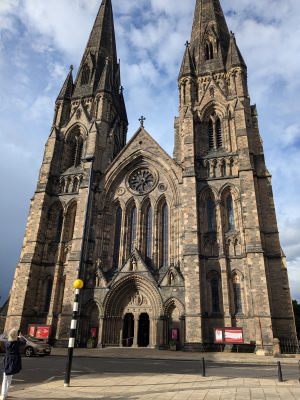
 We had a great evening the other night in St Mary’s Episcopal Cathedral, Edinburgh (see photo), listening to the four young finalists in the Directors’ Recital Prize competition run every year by St Mary’s Music School.
The competition is open to the final two years of students in the school, so most candidates were 17 or 18 years old. Each presented a 20-minute recital made up of two or three (or more) pieces. Most performed from memory. The standard was very high, so it was possible just to sit back and listen, feeling that we were in safe hands.
I was chairing the panel of judges, along with fellow judges Nikita Naumov, principal double bass of the Royal Scottish National Orchestra, and Jonathan Gawn, Wider Achievement Manager for instrumental music, Edinburgh Council.
I sat there reflecting on the mysterious difference between a programme which comes across as having been polished a thousand times in the practice room, and a programme which has been polished a thousand times (etc) but nevertheless manages to find an extra gear if the performer is able to allow new elements into their thoughts as they connect with this building, these acoustics, this instrument (in the case of the pianists who are playing a different instrument from usual) and this audience, who bring their own collective ‘vibe’ and focus.
How can one tell the difference between ‘here’s one I made earlier’ and ‘here’s one which is suddenly enhanced because of tonight’s ingredients’? It’s something to do with the way the performer listens to their own sound as it travels into the vast space of the cathedral – not just how they listen, but how they modify the sound in response to what they hear. It’s to do with the performer’s awareness of the audience, their body language, their ability to sink into the atmosphere of this particular evening. It’s how some players seem to find a new appreciation and enjoyment of the music they’re playing – which communicates itself to us listeners.
Some performers try to tune the audience out so that they can concentrate. That produces a particular atmosphere, which can be intense in its own right, but which can leave the audience feeling somewhat excluded. Other performers instinctively know how to ‘give’ their performance to the audience.
”Give, not ‘show'”, as Sándor Végh used to say. You know it when you hear it.


Totally agree with Sandor Vegh!
Perhaps that is what Busoni experienced at his ideal times onstage: “…when the instrument responds perfectly, when the best ideas come during the actual performance and, what is more, sound right straightaway.”
A lovely quote from Busoni. Thank you James.
One for my commonplace book.
If we made all of the performers do an improvisation on one of their pieces they would quickly become aware of their audience and the atmosphere of the evening.
James
In jazz, this kind of experience is usually summed up as “being in the zone.” It would indeed be fascinating to see how classical performers or composers improvise and how good they are at it. I would imagine that the likes of Chopin and Bach would be really good whereas I can see a composer like Haydn managing to get “in the zone” almost immediately.
It is fascinating when music “clicks” and captures the moment. Keith Jarrett has often spoken about this and I think that he is rather unique (the late Sonny Rollins comes as another example) of being able to have the creativity to improvise at length without resorting to a lot of meandering. In my opinion, the greatest pianist in jazz at getting into the zone immediately was Paul Bley who incidentally Jarrett’s favourite jazz pianist. I find Paul Bley to be so consistent as an improviser but also admire both JS Bach and Haydn because they seemed to have seem to share Paul Bley’s laser like focus. The closest I have come to hear this in a classical concert was Angela Hewitt performing Scarlatti. For me, that concert made the music sound spontaneous and almost improvised. This is watch all performances must aspire to.
Reading this, I can’t help thinking how pleased Joseph Haydn would be at hearing himself described as someone who could get in the zone almost immediately. I can imagine it too!
Susan
Good evening
There is so much economy in Haydn’s writing for piano. Nothing is wasted.
Haydn is a relatively new discovery for me as I wanted something different to sight read a few years ago and I was inspired by two unrelated issues. The first a dedication to Haydn in the form of a composition called “The door” by avant garde soprano saxophonist Steve Lacy which was dedicated to Haydn. The second was the fact that Horatio Nelson met Haydn when he returned from Naples following his sojourn after the Battle of the Nile. They were both great admirers of each other. I love the fact that they knew and liked each other.
I know you are a fan of Bill Evans but wondered if you had ever listened to Paul Bley and whether you were a fan too? The pianists are the Real heroes of jazz in my opinion and I think Paul Bley was one of the greatest. He is not as well known as he should be but I think most fans are converted as soon as they have heard him.
Cheers
Ian
Ian, I must admit I don’t know much about Paul Bley, but I will make a point of listening to one of his recordings.
Susan
Paul Bley was so prolific. i think there are something like 2000s albums he was involved with and independent labels seemed to record him regularly, particularly in the 80s and 90s. “Open , to love” is the most celebrated album but I think “Tango Palace” and “Tears” run that album close. They are all on Youtube. There are group recordings including number of trios with Paul Motian and I always loved “Fragments” which featured John Surman and Bill Frisell. What is interesting is that so many pieces continually appear in his repertoire such as “Closer,” “Ida Lupino” and “Seven.” These tunes appear on so many of his discs. Early in his career, we worked with Ornette Coleman which must have been a challenge for any chord-based instrument.
Cheers
Ian