
 The July issue of Gramophone has a review of my Nocturne book. The link doesn’t always seem to give access to the full article, so here’s the text:
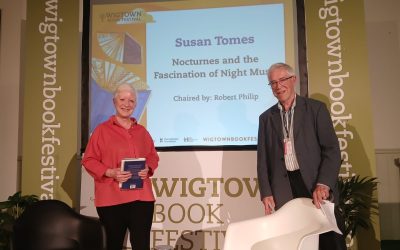
Claire Jackson reads Susan Tomes’s survey of the history of a genre – Nocturnes and the Fascination of Night Music
‘I seldom host visitors, so when recently embarking on a multi-generational soirée, I dithered over everything – especially the soundtrack. Stick with Haydn’s keyboard concertos, knowing they’ll have fizz no matter how long the bottle’s been open? Appease the newly minted teens (and, bizarrely, a dedicated elderly boomer) and play the latest KPop? Throw a curve ball with Oliver Leith’s 2022 opera Last Days, based on the end of Kurt Cobain’s life and wait to see if any Gen Alphas recognise the Nirvana nods? Eventually, I settled on Apple’s ‘Piano Chill’ playlist, featuring Hania Rani’s Riksarkivet and Sonatina for Nausicaa by Olivia Belli among its rotating dozens. What these disparate composers have in common is that the writing is – sometimes to its detriment – overwhelmingly tonal, meditative in spirit and evocative of evenings, referencing ‘the moon’s embrace’ (Chad Lawson) and The Quiet House (Kenzo Zurzolo). The streaming methodology might be new, but the concept of the nocturne – night music, inextricably linked with the piano – is not.
The development of this form is the subject of Susan Tomes’s superb book, Nocturnes and the Fascination of Night Music. Our story begins with erstwhile Clementi pupil John Field, now ensconced in St Petersburg’s musical life, where nighttime noodling has come to define a genre. Tomes identifies ‘a peaceful, slow piano piece of a few pages with a melody line in the right hand and a rippling arpeggiated accompaniment in the left hand … The harmonies are simple, focusing on the home key and the dominant key … The atmosphere is gentle and thoughtful’. Field’s nocturnes, though well received at the time, would go on to be eclipsed by Chopin’s – thanks in part to the former composer’s poor filing and sidelined legacy. After decades of research, Field biographer Cecil Hopkinson concluded, with scrupulous modesty: ‘This, unfortunately, must be set down as the most unsatisfactory record that has ever been compiled of the manuscripts of any well-known composer.’
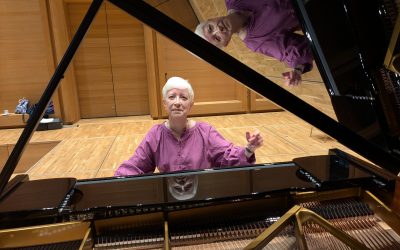
Field has, to some extent, been a beneficiary of contemporary historiography and the trend to give under-recognised composers their belated dues. In 2025 Alice Sara Ott released Field’s ‘complete’ nocturnes (DG, 3/25), music she came to explore during the Covid lockdowns. Her unfussy lyricism is the ideal advocacy for this music, which is described in technical detail (without notation) by Tomes, who played the 18 nocturnes in preparation for writing this book.
In the 2024 BBC cosy-crime series Ludwig, the titular puzzle-setter (David Mitchell) is seen undertaking a crossword, scribing ‘nocturne’ into the grid. The musical form has achieved a rare status in the lexicon, following ‘waltz’ or ‘symphony’. This is even more remarkable when we consider that Field essentially invented the term. Tomes reminds us that although ‘notturno’ existed as a title, the French form – the dominant language in Russian cultural life at the time – was not used until Field began applying it to his piano works written between 1812 and 1836. Since then, the style has been take up by composers of all stripes. Along with the expected – Fauré, Alkan, Schumann – there are some new names, such as Constanze Geiger (1835-90), whose ‘Kennst du meine Leiden?’ Tomes observes is a ‘technically demanding nocturne in G flat major with a surprising number of large stretches for the left hand, melodic passages played by the right hand in octaves, and decorative arpeggios for both hands simultaneously’. Lesser-spotted nocturnes by Cécile Chaminade, Kaikhosru Shapurji Sorabji, Louise Farrenc, Dave Brubeck, Vincent d’Indy, Georges Bizet and George Crumb are also included.
So too are composers from Apple’s ‘Piano Chill’ list. ‘One of the most successful, in terms of audience size, has been Ludovico Einaudi, who has enthralled stadium audiences with his composition “Night”,’ writes Tomes, sensibly acknowledging offshoots of the form. (Incidentally, those critical of the creeping tendency to overuse the pedal – an accusation often levelled at Einaudi and others in this field – might take comfort from Poulenc’s recommendation, translated by Tomes, regarding his eight nocturnes: ‘One can never use enough pedal, do you hear me! Never enough! Never enough! Sometimes when I hear certain pianists play my music I want to shout at them, “Put some butter in the sauce! What’s this dieting game?”’)
The big piece, in terms of scale and scope, in this broader category of night music is Max Richter’s Sleep, an epic eight-hour dose of tramadol, intended to reflect and even accompany a full night’s kip. At the recent Alexandra Palace performance, where I was one of the 800 people snoozing on single beds while the composer and his ensemble played from dusk until dawn, the letters people left on the noticeboard revealed the music’s impact in alleviating suffering. Sleep wasn’t composed as part of modern orthosomnia’s obsession with high-achieving rest but to comfort the lonely insomniac. We hope that through such soothing sounds we might share Frank O’Hara’s experience: ‘I was listening to a Chopin Nocturne when I woke up and suddenly felt so unalterably great just by the contact with it.’’
Gramophone, July 2026

Bravissima!
I had no idea that Dave Brubeck had written nocturnes but was aware that he had a second career in classical music. You can find recordings of these works on Youtube and think that they sound exactly as you imagine them. When I was getting into jazz in the 1980s Brubeck was a musician I was a bit suspicious of but as I gave grown older his piano playing has become more fascinating. Much of the positivity towards his quartet was centred on altoist Paul Desmond but, in my opinion, there is something different and original about his playing which makes him a for compelling soloist than the horn player. Most people are familiar with the “Time out” album which explored different meters and which sounds a bit twee with what musicians can do these days. The album inspired by a tour in Japan is more indicative of just how interesting a musician he could be. Brubeck studied with Milhaud which is another element that makes him a fascinating musician to listen to. I think that Brubeck is more valued these days than in his heyday but many jazz pianists whether Monk, Herbie Nichols Andrew Hill, Cecil Taylor etc, etc take a while to get their just due. For me, the real heroes of jazz are the pianists.
It is fascinating just how many jazz musicians dally in classical music starting from the times of James P Johnson right through to the likes of Dave Burrell. The same applied to the late, great Stanley Cowell who I met in Vienne many years ago and was a true gent- one of the nicest jazz musicians I have ever met.
I think the 1950s offered a lot of different approaches to jazz piano after the innovations of the great Bud Powell whether you consider the likes of Thelonious Monk, the neglected Herbie Nichols, Lennie Tristano or the anomaly of Errol Garner who I always think is jazz piano’s answer to the duck-billed platypus insofar that he was so unusual and whose style seem to come out of nowhere. I think Brubeck needs to be put in this category too.
In jazz, I think Ellington was the best composer when it came to evoking nocturnal music but nice to see reference to Farrenc and Chaminade who I admire too. I believe that Sorabji lived down the road in Corfe, Dorset.