
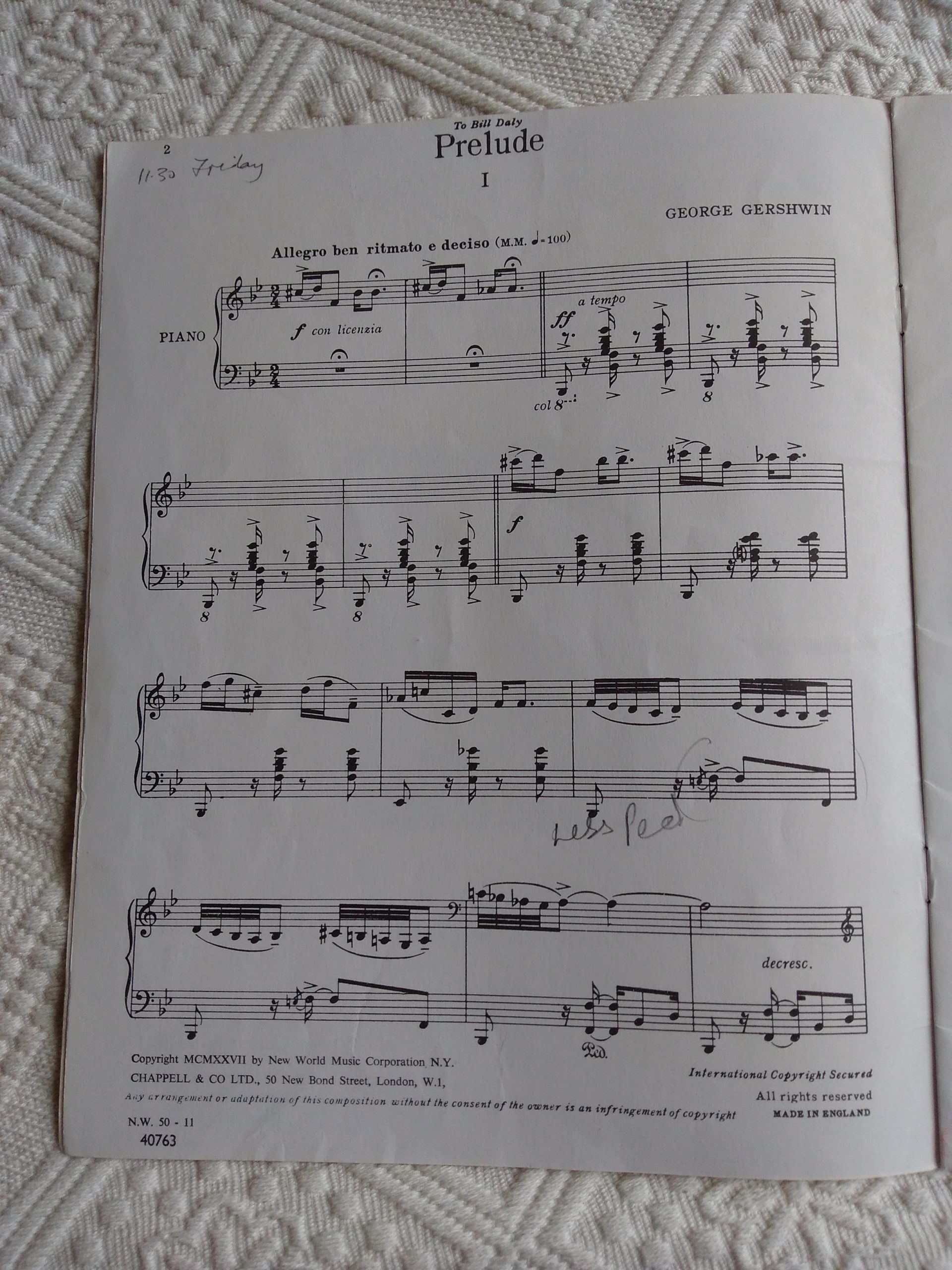
 This is probably the penultimate in my lockdown series about neglected music on my shelves. It has been a helpful focus for me during a phase when more people had time to read. As we start to come out of lockdown, it seems right to wrap it up. I’ll try to get to number 20!
Today I’m looking at George Gershwin’s Three Preludes. Not neglected, of course, but I haven’t heard them played in concert for quite a while. The three preludes are all we have of a projected series of 24 which Gershwin hoped would stand alongside other celebrated sets of 24 preludes, such as Chopin’s. Alas, he never got around to writing more than five, and two were somehow dropped along the way.
He premiered the Three Preludes himself at the Roosevelt Hotel in midtown Manhattan in 1926. The hotel had opened just two years earlier and was considered an icon of Jazz Age elegance. You can google photos of its gorgeous ballroom which still features a grand piano, and it’s easy to imagine Gershwin sitting at it in his pinstripe suit. It shows something about his milieu that his preludes were premiered in a ritzy hotel.
I’ve always felt that he secretly had a jazz band or an orchestra in mind when he wrote these pieces – it’s easy to imagine rasping clarinets, blaring trumpets and horns, double basses doing rich pizzicato, and a sizzling rhythm section. It’s as though the piano is being used to evoke other instruments.
Prelude 1 is probably the most successful, partly because it seems to invite a bit of swing. Number 2, which Gershwin called ‘a sort of blues lullaby’, has a sultry melody which is easier to play if you imagine your right hand is a clarinet or saxophone. In the middle episode I find it helps to imagine yourself as a singer with a deep bass voice – you can almost hear the words of his bluesy lament. In number 3, I can’t prevent myself hearing the words ‘It ain’t necessarily so’ (from Porgy and Bess) under the main theme. The piece has great energy, but the writing isn’t particularly pianistic, and as a consequence one often hears it played with more gusto than grace.
Gershwin was an accomplished pianist in a style tending towards hectic bravura. It was a very popular style of piano playing in the 1920s and had a big influence on the playing of Billy Mayerl, a Gershwin fan on the other side of the Atlantic. There’s a 1928 recording of Gershwin dispatching his Three Preludes with a sort of devil-may-care élan. Far from pulling his piano music around or lingering indulgently to show his emotions, it’s as though Gershwin wanted it downed in a single go, like a shot of whisky. Quick – there’s another party to go to!
For me, a little of this kind of playing goes a long way. I love Gershwin’s music, but have often felt there is more beauty in it than he cared to bring out when he played.

Interesting observation about Gershwin’s playing! Sometimes composers are better leaving their music in the hands of others…
Maybe you should aim for 24, Susan! 😉