
 I’ve been watching some of the Winter Olympics on TV and marvelling at the way that the top competitors all seem to achieve times which are within a fraction of a second of one another’s. Time and again the commentators point out that the winning margin is four-hundreths of a second or similar.
It’s sometimes a bit baffling to watch all these talented sportspeople who have trained for years, in different countries, to reach the same pinnacle of athletic achievement that their rivals also manage to reach. It feels as though more of a distance should separate the winners from the also-rans. As it is, the also-rans are often within a whisper of the medallists’ times. You feel that fate could so easily have shuffled the results so that three different people would end up on the podium.
It went through my head that people who go to listen to music competitions must feel similarly about the competitors’ achievements. Such talented musicians on such a high level, and all able to master the most difficult pieces with style and confidence! How on earth are the judges to distinguish between them? Surely there can’t be better playing than this?
I guess that in both cases, sport and music, the principal value for the competitors lies in the training. They can see what the top achievers in their field are doing and try to match it. In the process, they have to confront themselves and try to deal with whatever quirks or shortcomings separate them from the leaders. Quite often they manage it, too.
So if you just look at it from a human point of view and don’t worry about who exactly has won a medal, you can see the great benefit of committing to a rigorous training process and fighting your way through to being your best self. To the casual observer, it may look as if the competitors end up being kind of indistinguishable from each other, but perhaps that is not the point.

That is one advantage of competitions, the motivating factor of a black-or-white, win-or-lose event. With broader creative work though the goal is not to be “better” than anyone else, but just to be yourself.
Yes indeed – it makes one wonder about the wisdom of music competitions. With sports, the scoring can be objective (it either is the longest jump or it isn’t) but with music there are so many immeasurable factors involved.
I like Stephen Hough’s cheeky wit on this point: “The main reason for taking part in competitive sports is to try to win, but in music there are no real goalposts. It’s the main reason why music competitions do not exist. Oh, wait a minute…”
Yes – so well put by Stephen!
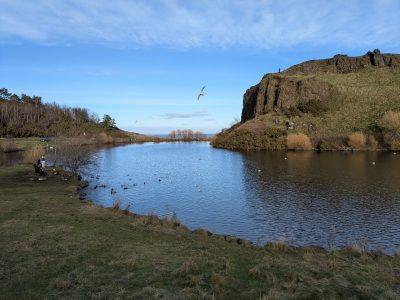
That is a curious photo. I do not recognise the location and was wondering about the cliff formation and the age of the rocks. There are some cliffs up from the beach down the road at Barton on Sea and archaeologists have found fairly recent fossils of crocodiles. Intrigued by the age of the rock in this photo. It is fascinating to learn about the origins of these rocks and what kind of animal life they would have witnessed.
The photo is of Dunsapie Loch in Holyrood Park, Edinburgh. The loch is halfway up Arthur’s Seat, the hill in the middle of the city. During lockdown, when everything was closed, an otter came to live in the loch. For some weeks in the winter it delighted walkers by swimming to the edge of the loch and playing among the stones there, even though there were people standing nearby. At the time, the appearance of a playful otter seemed strangely significant, as if it had come from another realm to cheer us all up in the middle of the pandemic. When the loch iced over, the otter disappeared.
Susan
Thanks for your reply. I have never heard of Dunsapie Loch but interesting to learn that it is just behind Arthur’s Seat which constantly crops up in Sir Ian Rankin’s excellent Rebus books. It did not realise that it was a 350 million year old volcano that was active in the Carboniferous period. I have been reading a lot of of books like “Otherlands” and Steve Brusette’s books about prehistoric life over the life two years. We have spent quite a bit of time on Dorset’s Jurassic Coast where you can see the layers of rock associated with each geological Era. I find it really fascinating that you can see clues in the contemporary landscape that tell you something about the landscape many millions of years ago. Having seen the two volcanoes of Mt Matutum and Mt Apo whist on holiday last month, it is fascinating to realise that there used to be volcanoes in the UK too.
Your story about the otter really resonates with me. I live in a village called Otterbourne and am aware that otters are present in many areas along the River Itchen. I have never seen one but when the first lockdown ended in 2020, my mother visited me and we went birdwatching along the river as the footpaths had been opened up. We saw a stoat hunting rabbits in a field and we were fascinated to see him in action. Ultimately, he was unsuccessful and was mobbed by a number of jackdaws in the field who did not like his presence. This is the only time I have ever seen a stoat in the wild. I have not seen him since. I never grow out of seeing unfamiliar animals, birds and insects. The stoat was something special and different from the deer, squirrels , hares and rabbits we usually get in Hampshire.