
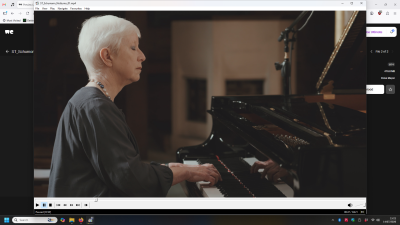
 I think I’ve mentioned that I have an album coming out on the Hyperion label in October. It’s a selection of piano music by some of the women featured in my book Women and the Piano, and adopts the same title. I hope it will work as a sort of companion to the book, and also, of course, as an album in its own right. It will be available from the Hyperion website, on streaming platforms, and as an actual CD. I’ve written the programme notes.
On the Hyperion website you can also listen to extracts from all the pieces on the album.
Today, Hyperion is releasing on its YouTube channel a ‘taster’ in the form of a little music video filmed during the recording sessions. I’m playing Clara Schumann’s beautiful Notturno, one of the pieces on the disc. This link should take you to the video.
A second track (audio only) will be released on 28 August, and a third on 18 September. The whole album comes out on 9 October. I’m looking forward to people hearing these gorgeous pieces.


Susan
Good evening
I have been a bit sceptical of both Clara Schumann and Fanny Mendelssohn in the past because they tend to get an adverse amount of attention as opposed to other female composers who are not so appreciated. However, I really liked that piece. IT was almost Chopin-esque. I do think that the the most celebrated composers enjoy a reputation for obvious reasons yet when you plough through less familiar repertoire, there are many composers who I have found have been overlooked to the extent that the established pantheon does need to be considerably broadened – certainly beyond the Germanic composers you mentioned in a previous blog.
I am intrigued by the composers on your new CD as it is good that you are championing the likes of Chaminade as I am a fan too. For me, it is Lili Boulanger who was the greatest female composer and I was not surprised to learn that she was jazz pianist Bill Evans’ favourite. I am also quite fond of Louise Farrenc who was at least the equal of FM and CS in my opinion. (Her music does seem to be divisive for some.) There is also a strong case for musicians such as Mel Bonis being credited for her role in writing music for children and amateurs – something that gets very overlooked these days and is probably a consequence of the way technical facility was so favoured post-Liszt in the 19th Century at the expense of keyboard writing in the era of Mozart, Haydn and Clementi. She still deserves some credit. Outside of piano music, I have been impressed by Emelie Mayer and Germaine Tailleferre albeit there seems to be so little of the latter’s music that get’s airplay. Even with a little casual research, there is so much beyond CS and FM.
I will be intrigued by the Syzmanowka track I had never heard of her until I had read your book. Anyone who influenced Chopin is worthwhile checking out in my opinion. ( I have to admit that Karol Syzmanowki who would be my nomination for the most under-rated / under appreciated composer. He is like an amalgam of Debussy, Scriabin and Bartok. )
As a bloke, it is fascinating to hear music from a female perspective. However, I do think that classical music is still playing catch up with jazz where the likes of Maria Schneider, Geri Allen, Esperanza Spalding, Satoko Fujji and Carla Bley have defined so much of what is good about the music. The jazz community seems less judgemental of gender and is more concerned with originally. There are quite a few “established” female composers in classical music and it is good to hear them getting their due on programmes such as the breakfast show on Radio 3. Hopefully, Classical world will get to the point where the true worth of these female composers will be recognised for the music they produced and also be put on a equal footing with their male counterparts I wondered if you concurred with me that it is composers like Caroline Shaw, Jennifer Higdon and Sally Beamish who are now setting the agenda in classical composition?
I feel lucky to have lived to see today’s advances in sexual equality in music. When I was a young pop fan, it didn’t seem to be thought remotely odd that Radio 1 had only one female DJ and that Anne Nightingale’s show went out at 9 on a Sunday evening!
James
I do feel that the reputations of classical composers will undergo a substantial revision in 21st century and that many of these “neglected female composers” will
end up having greater reputations that many of their more famous male counterparts. It is probably fair to say that there are numerous composers who are still overlooked and I just feel that a tiredness with the over-familiar repertoire and the desire to hear new music will ensure that there is an increased demand to hear these works. I do feel that this will mean that female composers will ultimately get their due whereas there will be other composers whose reputation will diminish.
Classical music is fascinating because so much of it is neglected. I have been listening to Rott’s E major symphony today whilst I work. What a brilliant piece of music it is! There are other composers who I greatly admire like Villa Lobos, Scriabin and Syzmanowski who are hardly household names yet deserve to be heard more too. However, I do think that checking our female composers is extremely rewarding and there are many who I feel are certainly more than match for their male counterparts. There is so much potential to uncover forgotten masterpieces amongst female composers. Composers like Florence Price and Amy Beach are now very much mainstream and there are swathes of others who will now give their more illustrious contemporaries a run for their money. I just feels like a sea change.
I have to say that I don’t really think we should be valuing many female composers because of their gender but looking at their reputations from the perspective that their contribution is often far greater than their male counterparts. This is clearly the case with contemporary composers where women are often setting the agenda yet I really feel that we are now in an era where the idea of a pantheon or a canon needs to be reconsidered too. I would not be disappointed to see the works of over-praised composers like Tchaikovsky and Grieg binned off and more consideration given to the likes of Boulanger or Farrenc. The more you delve into classical music, the greater the number of surprises you find. it is always worth exploring and challenging the perceived reputations.
I am keen to hear all sorts of neglected music and explore the unfamiliar. People are more keen to do this these days .
Thanks for these interesting suggestions. To be fair the problem of the stagnant repertoire has held male composers back too. When I lived near London and was a weekly concertgoer there, I used to despair after the eclectic and imaginative Proms to look at the autumn brochures and find the same old Hebrides-Schumann Piano Concerto-Brahms 1 programmes week on week. I longed to hear works by Finzi, Korngold, Moeran, Delius, Martinu etc, but the excuse was always “those wouldn’t sell”. Commercial caution always holds back the arts. All the time fine novels by unknown names are rejected by publishers so they can put out ghostwritten fluff by chat show hosts! When an unknown is given a chance, they often become the bestsellers of the future. And the classical repertoire does continue to evolve over time. For example, when I was young the Alpine Symphony, the Prokofiev 2nd piano concerto and Sibelius 4 were hardly ever played, but now all have fought their way into the core canon. Quite how that has happened if mysterious (sometimes the backing of a star player like Kissin helps), but thank goodness that is has!
James
Thanks for your reply.
I think audiences are more inquisitive than they were 20 years ago. I do think that programming is about capturing people’ imagination and piquing their interest. The last concert I went to included two pieces by Berlioz, some Debussy but also incorporated Lili Boulanger. There are some composers that put me off attending concerts (Brahms, Britten, Tchaikovsky, most 19th century Russian composers, etc) whilst there are composers like Beethoven that are familiar yet still are life-affirming. However, it is the chance to hear something unfamiliar which captures my imagination.
Hearing unfamiliar music that connects with you is one of the thrills of going to live gigs. It doesn’t always work such as one gig i went to in Basingstoke which mixed Bartok’s exceptional 2nd piano concerto with a piece of Elgar that fell flat as a follow on. Suffering the Elgar did not distract from he the fact that the Bartok was one of the best performances of classical music I have heard live. Returning to the topic of female composers, that would be an added attraction for me. I just feel that this is often unfamiliar and needs to be heard.
Picking up on the publicity for the new CD, this is exactly what I mean by piquing my interest. I am not saying that all female composers deserve renewed attention (there was an on line comment a few months ago regarding Priaulx Ranier where I think her music deserved it’s obscurity.) The notes suggest 19th century female composers often being limited to writing for the piano. I don’t think this is an issue at all. Piano composition offers so much possibility and the main movers and shakers in classical music have often established their reputation on the keyboard whether we are taking about JSB, Chopin or Debussy. You could also include Bartok but for the fact that his orchestral and string quartets were equally as original. The solo piano repertoire remains one of the most important elements of musical history and the fact that so many great female composers specialised in the instrument is not to the detriment of their reputations in my opinion.
I do feel that the tide has turned and that there are composers like Florence Price who are popular enough these days to put bums on seats.
Yes, for various reasons I haven’t been to a concert for a long time but I have noticed that thanks to conductors like Jurowski with the LPO the repertoire in London is much more eclectic than it used to be. I’m with you on Britten (there’s often a certain flashy hollowness there which leaves me cold), though I love Tchaikovsky’s best works, and I’d take Elgar over Bartok any day! How wonderful we all have such different tastes – life would be very dull if we were all the same…