
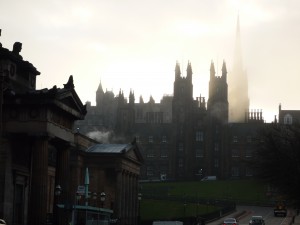
 I’ve been in Scotland, where I enjoyed seeing Raeburn’s portrait of the 18th-century Scottish fiddler Niel Gow in the Scottish National Gallery in Edinburgh. I was amused by the information beside the painting, which explained that ‘as a fiddler, Gow was especially acclaimed for the strength of his up-bow, or returning stroke.’ Never have I heard a violinist’s up-bow singled out for particular praise. After all, one in every two strokes is an up-bow, and it’s hard to imagine quite what it was in Gow’s playing style that featured the ‘returning strokes’ so memorably. Or perhaps one could wonder what everyone else’s up-bows were like!
The poet Robert Burns knew Niel Gow, and I loved Burn’s description of him as having an expression of ‘kind open-heartedness mixed with unmistrusting simplicity.’ Unmistrusting! What a delightful choice of word, subtly different from ‘trusting’.
You might be surprised to discover how much time and print is devoted to discussing the merits (or otherwise) of violinists’ up bows! One article on the subject in a learned tome provoked heated argument in its letters column for months afterwards! And there is also the difference between bow strokes in traditional (folk) fiddling and classical playing (not to mention the development over the last two centuries in bow construction). I once took some classically trained players to a folk fiddle workshop and we all got very tired right arms trying to emulate the (very crunchy) down bow emphases. So perhaps Niel Gow had ‘non-unequal’bow strokes!