
 I was on my way to Wigmore Hall in London for my recital a few days ago when this very pleasing review of my Nocturne book popped up on Presto Music. I think reviews are a new kind of offering on Presto Music, so in case readers haven’t come across it, I thought I’d put some excerpts here:
‘…The book is as hard to put down as the best of fiction yet with research and accuracy always forefront, as readers of her previous books, including The Piano: A History in 100 Pieces, will recognise.
‘…The range of composers and repertoire Tomes calls upon is limitless, displaying a knowledge that reflects a life lived deep in the love and practice of music, and the exploration of the connections with wider arts in the closing chapters evidences the rounded artist and writer that she undoubtedly is.
‘…This is a book you won’t want to put down, full of fascinating facts and interesting anecdotes, unfailingly engaging and guaranteed to prompt you to rediscover music you thought you already knew, and to discover music you don’t, whether as listener, musician or both. It is beautifully written, usefully and comprehensively indexed and bound and typeset to the highest of standards by Yale University Press.’
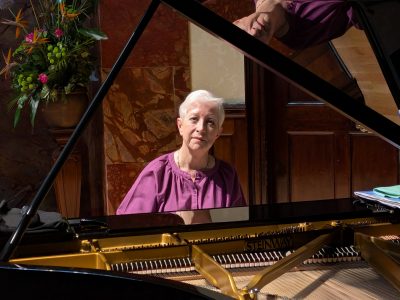
Seeing this review gave me a jolt of confidence and I made my way to Wigmore Hall with a spring in my step. (Photo shows me rehearsing on stage that day.)


Hooray! A wonderful recital, too! Thank you.
Thank you Alison. I’m glad you were able to be there!
I would agree with all of that – I am reading the book slowly as I don’t want it to end. Two minor thoughts it has prompted, both about posture at the piano. You say at one point that the right pedal is used by the right foot. Being left-handed (and -footed) I always use my left foot, as that is where my dexterity and sensitivity is centred. This is one reason why I don’t use the left pedal (my current, digital piano doesn’t even have one). I wonder if many other left-handed pianists do this, or even if some enterprising manufacturer has ever made a left-handed piano with the pedals the other way round! Secondly, last night I tried out Chopin’s proposition that the most comfortable scale under the hand is B major. How right that turns out to be.. I wonder why so few piano teachers have followed his example in starting pupils with that scale rather than the apparently benign by actually clumsy C major. Quite apart from anything else it would help novices lose their fear of black notes. Usually the attitude is “We’ll come to those when you’re more advanced”, but apart from having to remember which keys use which black notes they aren’t inherently more difficult. I then started to wonder if one reason they seem that way is because they ARE black! If they were a more gentle colour – dark blue for example – perhaps they would seem more friendly and approachable. Of course I hardly expect a multi-coloured keyboard to take off at this late stage! But the piano does always give us, and in numerous ways, plenty to ponder on….
Such interesting thoughts, as ever, thank you James! I love the notion that the piano keyboard could have blue notes. Who knows what a multi-coloured keyboard might do to our perception of music!
James
That is a brilliant post. I have a fear of keys with sharps in but am more relaxed with flats. However, seeing notes above and below the staves in the higher and lower registers is more off-putting for me with music where you have to cross hands the ultimate turn off personally.
I am not sure if you were aware of the Harlem Stride pianists who emerged during the 1900s and held sway until the mid thirties in jazz after which other innovations tended to render their style as old fashioned. James P Johnson, a composer / songwriter as well as pianist is seem as a pioneer but the main aspect of their music was to make the playing as complex /challenging as possible to discourage competition. One way in which they did this was choose keys with loads of sharps and they were all very comfortable in these keys. The most famous protagonist was Fats Faller who made a famous quip towards a less talented pianist along the lines of “what key are you struggling in?”
These pianists were really fantastic but I would also thoroughly recommend you check out Earl Hines who evolved this music into something very original. There is a Hines / Louis Armstrong duet called “Weatherbird” which is one of the greatest flights of improvisation this century.
This school of piano playing which requires loads of technique and stamina. They tended to come from a schooled / musically educated background and your often find some “light” classical works reworked in this idiom. The thing that always impressed me was how many notes they could have stretched. The must have had hands like shovels.
I am amused by the idea of “coloured” keys. It is interesting but would ultimately end in a bun fight amongst composers arguing what colour should be assigned to what note. Wondered if you had ever attempted, like me, trying to read Scriabin. Can just about sight read the easier pieces but I feel his piano music was written to describe a melange of colours.
Thanks for your very interesting thoughts. I didn’t know about that school of jazz pianists who tried to be as difficult as possible to thwart competitors! I do think that one reason why classical music became so wildly complex in the early 20th century was out of resentment at the rise of popular music. There was a determination to prove one’s technical and therefore general superiority, an attitude summed up by Schoenberg: “If it’s popular it’s not art, and if it’s art it’s not popular.” Then again I suppose competitiveness has always been a part of human nature. Beethoven was listening to another pianist improvising proudly to his utmost ability, then asked witheringly: “When are you going to start?” This did not make him very popular!
I should emphasize my suggestion of different coloured keys only related to finding a less intimidating colour for the black keys. A truly multicoloured piano would be a bewildering sight! Then again, given the eccentricities which have been perpetrated in the name of classical music in recent times I’m surprised nobody has made one (perhaps they have).
As for reading complex scores, I’m afraid I have something akin to musical dyslexia which has always made my reading of scores difficult. I’ll certainly stay away from Scriabin! Fortunately I can improvise fluently and compose fairly well, so those are my main sources of pianistic pleasure these days.
James
I think the complexity and competitiveness has always been there in music regardless of in classical music or jazz. Although I like earlier composers like Bach, Haydn and Scarlatti, I got into classical music through jazz and the 20th century composers were the ones for which I had an immediate connection. I don’t find the music too difficult or challenging and it resonates with me more than say Mozart.
I do find that competition can result in boring music and am not a fan of recordings like the tenor battles between Dexter Gordon and Wardell Gray. Gordon was so much better when he just focused on the musical aspect of his playing as on the later Blue Note records. For me, the Harlem Stride school of pianists are interesting because the competition and the creativity it promoted do seem more musical regardless of the difficult keys they chose to perform in. One of the things about historical jazz that frustrates me is that there is a perception that early jazz was crude. These pianists had incredible technique and were all classically trained – insofar that popular , classical repertoire is used used to play jazz. By the time you get to the likes of Art Tatum , the music became really sophisticated and you find covers of Dvorak’s “Humouresque.” Many of these players never actually recorded but you can hear records by James P Johnson, Willie “The Lion” Smith, Don Lambert and Fats Waller easily enough.
Funny that Chopin though B major was the easiest key to fit the shape of the hand. Have you seen the recent French film “Chopin, Chopin!” about him ? I got about halfway through and gave up. It was ok but the context was the most interesting thing about it as I never knew he survived an epidemic. The film made him seem quite smug and a bit irritating. I am not sure how accurate it was. Many composers do not seem to have been that agreeable as you allude with Beethoven. I have always thought Haydn was a good bloke and love the fact that he met Horatio Nelson when the later was returning from his escapades in Naples.
I’m not a pianist or a musician of any kind, but am enjoying this discourse (and reading Nocturnes).
Googling for ‘colourful piano’ led to some striking images and also this article:
https://www.londonpianoinstitute.co.uk/synesthesia-and-piano/