
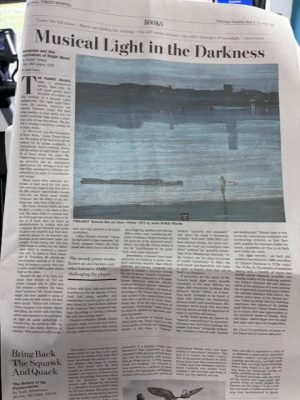
 I mentioned a couple of days ago that my book was about to be published in the US. This morning I was delighted to find a generous review in the Wall Street Journal (see photo), headed ‘Musical Light in the Darkness’. The link is this, but after a couple of paragraphs it may disappear behind a paywall, so here’s an excerpt:
‘In Nocturnes and the Fascination of Night Music, Susan Tomes delves into the origins of the nocturne and the reasons for its popularity. A Gramophone-Award-winning pianist and the author of eight books – nearly all of them about the piano – Ms Tomes brings to her work a commanding authority and an undisguised appreciation. Her writing is never less than clear, sustained by a lifelong commitment to the piano as practitioner and teacher. …
‘One night recently I sat back and imbibed Ivan Moravec’s 1966 recording of Chopin’s Nocturne in D flat major (opus 27 no 2), seven and a half minutes of sustained beauty with a breadth of vision that hardly seems humanly possible – the singing quality of the opening melody, the balance between the two highest parts at the entrace of a new melody, the heightened emotional pitch before the opening melody’s final return, the silvery grace notes in the closing gesture. I have no doubt that my listening experience was enhanced by reading Nocturnes.
Susan Tomes invites us to return with new appreciation to the wonderful works of Chopin, Field and others – and to linger over the spell that night casts upon our imagination.’
John Check in the Wall Street Journal, April 29, 2026



Lovely!
Here’s a link to an unlocked version of the review, which should take it out from behind the paywall.
https://www.wsj.com/arts-culture/books/nocturnes-review-musical-light-in-the-darkness-c5f2203a?st=YqRRhk&reflink=desktopwebshare_permalink
Betsy, thank you! This will be so useful.
How gratifying for you. Just a minor point: I was hoping to find your opinion of Delius’s ‘Paris – Nocturne, The Song of a Great City’ in the book, but I suppose there just wasn’t room for everything….
James, I confess that I hadn’t realised Delius’s ‘Paris: the Song of a Great City’ was subtitled Nocturne. I don’t think I’d ever come across that subtitle. You are ahead of me there!
The ‘Nocturne’ subtitle isn’t always listed when the piece is played in concert or recorded but it does seem to be part of the official title. Wikipedia says the “full title” is ‘Paris, A Night Piece – The Song of a Great City’. I think this helps to make sense of the piece, and I confess I do sometimes lose my way in Delius’s music…
James / Susan
I love Delius’s music but am not aware of “Paris.”
If you want an obscure Nocturne which deserves to be pulled from neglect, I would recommend Nicanor Abelardo’s First Nocturne. I am quite intrigued by the classical music from the Philippines which often reflects the politics of the late 1800s / early 1900s as Spanish rule was thrown off and replaced with the American occupation. Some of the earlier composers obviously had a Spanish influence but later on they were clearly listening to Debussy and even Sousa who was popular at that time. There is an interesting CD by Sally Pinkas of this music. It is not all great and some of the music is of it’s time yet the better composers like Abelardo, Santiago and Buencamino don’t deserve to be forgotten. I was surprised how good some of this music is even if it is unknown in the West.
I like the Abelardo nocturne which is reminiscent of Chopin albeit it was composed in 1921. He was a prolific composer but is better known for his song writing for which there was a tradition of “Kundimans” which were love songs often played on guitar. In my opinion, it is fascinating to discover that a nocturne like this was being written in the Philippines. I had never realised that Classical music was being written there albeit, in the case of Abelardo, there was a cross-over into popular music as was the case with his contemporary George Gershwin. Oddly enough, this nocturne was written only a few years before Fred Elizalde brought a band of American musicians to the Savoy Hotel in 1927 and helped establish a more authentic approach to jazz in the UK. Most people assume he was also American but Elizalde hailed from Manila. After the band broke up, he studied with De Falla in Spain and eventually return to the Philippines where he returned to classical composition.
https://www.youtube.com/watch?v=1PjaHnUAGDM
Thank you for the recommendation. ‘Paris’ is a rarity in the concert hall – in fact I have only been able to hear it once. The conductor was Bramwell Tovey and I remember in his introductory remarks he described Delius’s village Grez-sur-Loing as “about half an hour south of Paris”. Pause. “Actually if you’re French it takes about fifteen minutes.” Big laugh!